
Giving a voice to individuals with apraxia of speech

Living with primary progressive apraxia of speech
We share lived experiences of primary progressive apraxia of speech (PPAOS) and related speech conditions through personal stories, films and poetry. A diagnosis can help explain changes in speech, but it cannot tell the whole story. Here, people describe how communication has changed, what matters to them and how they
Living with primary progressive apraxia of speech
What is PPAOS
Primary progressive apraxia of speech, usually shortened to PPAOS, gradually affects the brain’s ability to plan the movements needed for speech. Someone may know exactly what they want to say but find it increasingly difficult to produce the words clearly.
PPAOS is different from primary progressive aphasia, which affects language, although a person’s symptoms and diagnosis can be more complex. No two people will have exactly the same experience. The accounts below are personal stories, not a guide to how everyone’s condition will develop

Tim Schut: sharing his story with family and friends
Tim's story

Known for connecting people in his community, Tim has spoken openly about what changing speech means for his work, friendships and family life.
Tim describes his diagnosis journey. After nearly a year of trying to find what was wrong with Tim’s speech, he was referred to Mayo Clinic. On June 21, 2021 within 40 minutes, Tim was diagnosed with Primary Progressive Apraxia of Speech. It is very rare—one in a million. But Tim has not let this disease stop him, he’s done three podcasts, one interview and in April 2022, he will speak to the world-renowned doctors and researchers at Mayo Clinic.
Book and podcast

Through video and his book, American Boy: The Story of Tim Schut, Tim records the experiences and lessons he wants to share with his children and future grandchildren.
TED Talk by Tim Schut
American Boy- Tim Schut

Tim explains why he wrote his book. Tim also didn’t expect to hear the doctor share a shortened life expectancy of ten to fifteen years. Yet this prognosis has not slowed Tim’s determination or drive to help others. Rather than hide from this disease, he’s choosing to share his story.
In this book, Tim has documented his life and the lessons he’s learned to benefit his children and future grandchildren. Today, Tim has a new superpower, optimism, and in these pages, he’s sharing the wisdom and perspective that has propelled him to incredible levels of family, community, and career success. Read this book and learn from the
stories of a man deeply connected to the elements of life that matter most.
I sometimes talk slow; I don’t think slow.
John Corvino:

Rory Barnes: finding another way to speak
Getting to know Rory Barnes

Rory Barnes spent much of his working life as a solicitor, using spoken language every day. After that long career, he turned to writing poetry. In 2016, when he was 74, he began to find it difficult to articulate words during conversation. The change was gradual. Three years later, he was diagnosed with primary progressive non-fluent aphasia.
Rory’s poems, Shouting from far away:
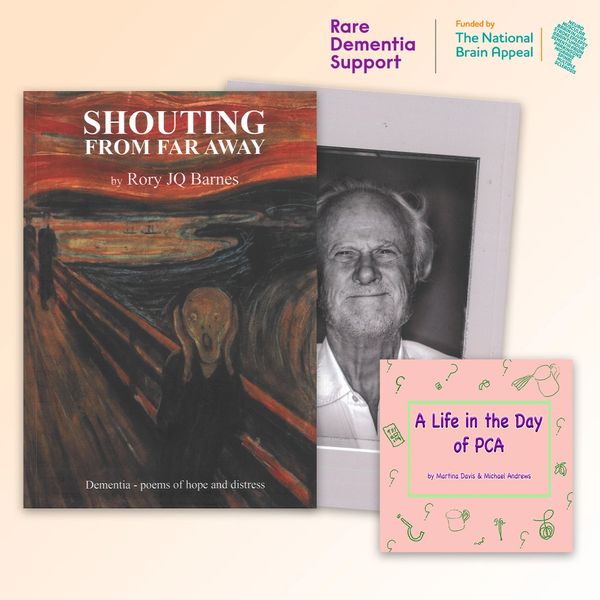
Rory’s three poems approach life with changing speech from different angles. The last sweet reflects on time and the value of what remains. An evening out conveys the pressure of speaking when others fall silent to listen, including the worry that they may pretend to understand. Fifi is about his relationship with his granddaughter and finding another way to remain part of her life.
Together, the poems invite readers to listen to Rory as a writer and a person, as well as to learn about his condition.
Changes in speech

Apraxia of speech became the most prominent feature of Rory’s condition. At the time his poems were published, he could produce only a few spoken words, with considerable effort, and they were often difficult for others to understand. He also experienced difficulty planning other movements of his face and mouth. The account of his condition makes an important distinction: severe difficulty speaking does not mean a person has lost their thoughts, understanding or inner life.
Communicating now

The published account describes Rory using an iPad with a voice-synthesising app to communicate face to face. Typing had also become harder for him. He sometimes made spelling mistakes or confused “yes” and “no”. Despite these challenges, he continued to write poetry about his experience. His writing allowed him to share thoughts that had become difficult to express in conversation.
Read Rory Barnes and Jason Warren’s published account, Shouting from far away: three poems about living with speechlessness.
Living with primary progressive apraxia of speech
Chris Kamara
He’s known for his famous catchphrase ‘Unbelievable Jeff!’ during his football commentary each weekend, but in 2020 Chris Kamara found himself struggling with his speech. He was later diagnosed with a rare condition called Apraxia of Speech (AOS) which is the subject of his new documentary ‘Lost For Words’. Chris joined the Britiish channel ITV alongside his close friend Ben Shephard to share his story. . Watch his film Chris Kamara: Lost for Words - ITVX
Https://merseysportlive.co.uk/2024/06/09/chris-kamara-on-apraxia-diagnosis-and-lack-of-uk-funding/
Chris Kamara's autobiography

The smash hit Sunday Times bestseller. Winner of Autobiography of the Year at the Sports Book Awards
Presenter, commentator, (sometimes masked) singer, footballer, manager and campaigner, Kammy has done it all. His irrepressible enthusiasm and a couple of legendary gaffes on Sky Sports have seen him become broadcasting royalty.
Now Kammy reveals all in this funny and moving autobiography. What happens when you double-cross José Mourinho? What's it like to play with Vinnie Jones? Who comes off better: Kammy or a rampaging gorilla? How did Kammy end up releasing his own top-ten record? What's the real story behind his infamous line, 'I don't know, Jeff!'?
But, despite the crazy tales, it hasn't all been plain sailing. Kammy had a tough upbringing, faced racism during his playing career and has, in recent years, dealt with a rare brain condition apraxia that has affected his speech and saw him say goodbye to Sky Sports. Sharing the details of his battle against the condition, Kammy shows how he’s met every challenge with courage, determination and that trademark infectious smile.
John Corvino
John Corvino
One of Philosophy’s Most Influential Public Voices May Lose His Own. This newspaper article focuses on John Cornino, a US philosophy professor “Basically, the parts of my brain that tell my mouth how to produce speech are gradually shutting down. He is quoted as saying "Over time my speech is likely to worsen, and eventually I may not be able to speak at all.” he shares that he was diagnosed with an unusual neurodegenerative disorder, Primary Progressive Apraxia Of Speech (PPAOS), which is resulting from FrontoTemporal Degeneration (FTD) in the right front lobe of his brain.
I Traveled the World as a Public Speaker. Soon I May Be Unable to Talk (Exclusive)