
Giving a voice to individuals with apraxia of speech
Prosody and apraxia of speech
Our Approach
Services for Children
Services for Children
At Speech Apraxia International – Raising Awareness and Providing Support for Apraxia of Speech, we provide individualized and evidence-based speech therapy services for children and adults. Our approach is centered around helping our clients achieve their communication goals and improve their quality of life.
Services for Children
Services for Children
Services for Children
We offer a range of speech therapy services for children, including assessment, diagnosis, and treatment for various speech disorders, language disorders, and communication difficulties. We also provide early intervention services for infants and toddlers.
Services for Adults
Services for Children
Services for Adults
We provide speech therapy services for adults with communication difficulties related to stroke, traumatic brain injury, Parkinson's disease, and other conditions. We also offer accent modification and voice therapy services.
Our Team
Contact Us
Services for Adults
Our team of licensed and certified speech-language pathologists has extensive experience and training in the field of speech therapy. We are dedicated to providing our clients with the highest quality of care and support.
Blog
Contact Us
Contact Us
Our blog features articles and resources on a variety of speech and language topics, including tips for parents, strategies for therapy, and news in the field of speech therapy.
Contact Us
Contact Us
Contact Us

If you hant, please contact us. We wo
Below is a comne page structure based on the prosody material currently embedded in your diagnosis page. I’ve rewritten and reorganised it so the new page is clearer, less repetitive, and useful to families, adults and professionals.
SEO setup
Recommended URL
https://speechapraxia.co.uk/prosody-and-apraxia-of-speech
SEO title
Prosody and Apraxia of Speech: Rhythm, Stress and Intonation
Meta description
Learn how apraxia of speech can affect prosody, including rhythm, stress, pitch, pace and intonation. Explore assessment methods and practical support.
H1
Prosody and Apraxia of Speech
Primary keyword
prosody and apraxia of speech
Secondary keywords
Prosody in childhood apraxia of speech
CAS and prosody
Apraxia speech rhythm
Abnormal speech stress
Prosody assessment
Speech intonation difficulties
Robotic-sounding speech
Lexical stress in CAS
Acquired apraxia prosody
Speech prosody exercises
Avoid forcing these phrases into the copy. Natural language is more important than keyword density.
---
Complete page copy
Prosody and Apraxia of Speech
Prosody is the rhythm, stress, pitch, pace and melody of speech. It helps listeners understand not only the words being spoken, but also the speaker’s meaning, attitude and emotions.
Apraxia of speech can disrupt prosody because the person has difficulty planning and programming the precise movements needed for speech. Their speech may sound slow, segmented, unusually stressed or “robotic”. There may also be pauses between syllables or words while the next sequence of movements is being planned.
Prosodic differences can occur in both childhood apraxia of speech (CAS) and acquired apraxia of speech (AOS). However, prosody must be considered alongside the person’s other speech characteristics. Prosodic differences alone do not confirm a diagnosis of apraxia.
Suggested buttons
Learn about childhood apraxia of speech
Learn about acquired apraxia of speech
How speech apraxia is assessed
---
What is prosody?
Prosody describes how we use our voice across syllables, words and sentences. It is sometimes described as the “music” of speech.
When somebody speaks, they continually adjust their pitch, loudness, timing and emphasis. These adjustments help them:
Highlight important information
Separate words and phrases
Distinguish a statement from a question
Communicate emotion and attitude
Keep the listener engaged
Make speech easier to follow
Change the meaning of a sentence without changing its words
For example, stressing different words in the sentence “I didn’t say she took it” can change what the speaker is implying.
---
The main components of prosody
Stress
Stress is the emphasis placed on a syllable or word. A stressed syllable is often longer, louder and produced with a change in pitch.
Lexical stress is the stress pattern within a word. For example, the first syllable is stressed in “TAble”, while the second syllable is stressed in “beGIN”.
Contrastive stress highlights important information within a sentence:
“The DOG is loud” answers “What is loud?”
“The dog is LOUD” answers “How does the dog sound?”
Incorrect or equal stress can make words harder to recognise and speech more difficult to understand.
Intonation
Intonation is the rise and fall of pitch across speech. Falling intonation is commonly associated with statements, while rising intonation is often used for questions.
Intonation also communicates feelings such as excitement, uncertainty, sadness or surprise.
Rhythm and phrasing
Speech rhythm is created by the timing and pattern of stressed and unstressed syllables. Phrasing divides speech into meaningful groups.
A disruption to rhythm or phrasing may cause speech to sound segmented, with inappropriate breaks between syllables or words.
Pitch
Pitch describes how high or low a voice sounds. Changes in pitch contribute to intonation, emphasis and emotional expression.
Loudness
Loudness can highlight important words and communicate emotion. Producing louder speech also changes the movements and physical effort involved in speaking.
Pace or speech rate
Pace is how quickly or slowly a person speaks. Some people with apraxia speak slowly because they require additional time to plan each speech movement.
Speech may become less accurate when the person tries to speak more quickly.
Pausing and juncture
Pauses can mark punctuation, separate ideas and make speech easier to understand. Juncture refers to how pauses work together with changes in pitch and rate to signal boundaries between words and phrases.
Unexpected pauses can alter meaning or make connected speech difficult to follow.
Voice quality and emotional tone
The way a voice sounds can help communicate joy, worry, anger, sadness and other emotions. Limited vocal variation may make it harder for a listener to interpret the speaker’s intended emotional meaning.
---
How can apraxia affect prosody?
A person with apraxia of speech may display one or more of the following characteristics:
Slow or effortful speech
Unusual pauses between sounds, syllables or words
Equal stress across syllables
Stress placed on the wrong syllable
Difficulty maintaining a natural speech rhythm
Limited variation in pitch
Intonation that does not fit the message
Syllables produced separately rather than as a smooth word
Difficulty changing loudness or emotional tone
Speech that sounds monotone, choppy or robotic
Greater difficulty with longer, multisyllabic words
Reduced intelligibility in connected speech
The pattern varies considerably between individuals. These features can also occur in other communication disorders, so they should not be interpreted in isolation.
---
Why does prosody matter?
Prosody plays an important role in both speech production and understanding.
It helps listeners identify word and phrase boundaries, recognise a speaker’s intention and focus on the most important information. Prosodic errors can therefore reduce intelligibility even when individual consonants and vowels are relatively accurate.
Prosody also supports early communication development. Babies and young children respond to the rhythm and melody of speech before they understand all the words being used. These patterns can help children recognise language structure and learn new words.
For older children and adults, prosody also affects social communication. A message can be misunderstood when its vocal tone does not match the speaker’s intended emotion or meaning.
---
Prosody in childhood apraxia of speech
Difficulty producing appropriate prosody—particularly lexical or phrasal stress—is one of the characteristics considered during an assessment for childhood apraxia of speech.
A child might:
Stress every syllable equally
Place stress on the wrong part of a word
Separate the syllables in longer words
Use limited intonation
Omit syllables from multisyllabic words
Find it difficult to imitate a new stress pattern
Produce different stress patterns across repeated attempts
By around eight years of age, typically developing children generally use prosody in an adult-like way. However, age, language, dialect and the child’s overall communication development must all be considered during assessment.
No single prosodic characteristic provides a definitive diagnosis of CAS.
---
Prosody in acquired apraxia of speech
Acquired apraxia of speech can occur following a stroke, brain injury or another neurological condition. The person usually knows what they want to say but has difficulty planning the movements required to produce it.
Possible prosodic features include:
A slow overall speech rate
Lengthened sounds or syllables
Segmented speech
Pauses within or between words
Equal or misplaced stress
Difficulty producing natural intonation
Effortful initiation of speech
Acquired apraxia frequently occurs alongside aphasia or dysarthria. A comprehensive assessment is needed to determine which condition—or combination of conditions—is affecting communication.
---
Is altered prosody always caused by apraxia?
No. Changes in pitch, loudness, rhythm or speech rate can occur in several speech, language and neurological conditions.
For example, dysarthria may affect prosody because of difficulties with muscle control, breathing, voice or resonance. Autism and some language disorders can also be associated with differences in intonation or stress.
Language and dialect are particularly important. A stress or intonation pattern that sounds unusual to one listener may be typical within the speaker’s linguistic community.
An assessment should therefore consider:
The person’s age
Languages and dialects spoken
Medical and developmental history
Voice and breathing
Muscle strength and coordination
Speech sound accuracy
Language ability
Consistency across different speaking tasks
---
How is prosody assessed?
A speech and language therapist may use perceptual assessment, acoustic analysis or a combination of both.
Perceptual assessment
Perceptual assessment involves listening carefully to the person’s speech.
The therapist may evaluate:
Lexical and contrastive stress
Intonation
Speech rhythm
Phrase boundaries
Pitch
Loudness
Speech rate
Pausing
Emotional tone
This approach is practical and can be used during conversation or structured activities. However, it is partly subjective and may be influenced by the listener’s own language and dialect.
Acoustic assessment
Acoustic assessment uses recordings and specialist software to measure features such as:
Syllable duration
Pitch and pitch movement
Loudness
Timing
Pauses
Lexical stress
It can provide more objective information but requires appropriate equipment, expertise and additional analysis time.
Informal speaking tasks
Depending on the person’s age and abilities, assessment activities might include:
Spontaneous conversation
Repeating words and sentences
Producing multisyllabic words
Describing pictures
Reading a standard passage
Asking and answering questions
Retelling a story
Using different emotions or character voices
A therapist may compare performance across single words, sentences and connected speech.
---
Formal prosody and motor-speech assessments
The choice of assessment depends on the person’s age, communication profile and the purpose of the evaluation.
Dynamic Evaluation of Motor Speech Skill — DEMSS
DEMSS was developed for the differential diagnosis of childhood apraxia of speech. It is intended for children aged three years and older and examines speech accuracy, consistency, vowels, prosody and the child’s response to cueing.
Verbal Motor Production Assessment for Children—Revised — VMPAC-R
VMPAC-R evaluates neuromotor speech skills in children aged approximately three to twelve years. It includes speech movement, sequencing, prosody, resonance, loudness and speech rate. It is not specific to CAS.
Profiling Elements of Prosody in Speech-Communication — PEPS-C
PEPS-C assesses the understanding and production of prosody. It examines areas including stress, intonation, phrasing and communicative function. It can be used with children aged four years and older but was not designed specifically to diagnose CAS.
Prosody-Voice Screening Profile — PVSP
PVSP is a screening system covering aspects of prosody and voice, including stress, speech rate, pitch, loudness and resonance. It has been used across a wide age range. Administration requires training, and available normative information is limited.
> Assessment tools should be administered and interpreted by an appropriately trained professional. A test score should not be used as the sole basis for diagnosing apraxia of speech.
---
Supporting the development of prosody
Intervention should be selected for the individual and incorporated into a broader motor-speech treatment plan where appropriate.
Possible activities include:
Practising lexical stress
The therapist can contrast correct and incorrect stress patterns and use visual or physical cues to mark the strongest syllable.
When a child omits a syllable, it is important not to teach an inaccurate stress pattern simply to make the missing syllable more noticeable.
Backward chaining
Longer words can sometimes be built from the final syllables backwards. For example:
“vision”
“le-vision”
“te-le-vision”
Each stage should preserve the target word’s natural stress pattern.
Contrasting questions and statements
Rising and falling intonation can be practised by comparing:
“The dog is loud.”
“Is the dog loud?”
Visual lines, arrows or gestures can be used to represent the direction of the voice.
Using contrastive stress
The speaker practises placing emphasis on different words to change the focus:
“The DOG is loud.”
“The dog is LOUD.”
Stories and role-play
Story reading, character voices and role-play provide opportunities to practise pitch, loudness, pace and emotional expression in a meaningful context.
Singing and rhythmic activities
Songs, rhymes and rhythmic vocal play can draw attention to syllables and speech patterns. With very young children, adults can model and imitate cooing, babbling and other age-appropriate vocalisations.
These activities are not substitutes for assessment or individualised therapy.
---
Technology used to examine prosody
Clinicians and researchers may use software that displays pitch, loudness, waveforms or spectrograms.
Examples include:
Praat
Waveform, Spectrogram and Pitch tools
Voice-analysis applications
Specialist prosody assessment software
Visual feedback can help some people notice changes in their pitch or loudness. Technology should support—not replace—a clinician’s perceptual assessment and professional judgement.
---
When should you seek help?
Consider contacting a speech and language therapist if a child or adult:
Is consistently difficult to understand
Has unusual or misplaced word stress
Speaks with frequent pauses or segmented syllables
Has lost previously established speech abilities
Has developed speech difficulty following a stroke or injury
Sounds noticeably slow, effortful or monotone
Becomes frustrated or withdraws because speaking is difficult
A sudden change in speech can require urgent medical attention, particularly when accompanied by facial weakness, confusion, weakness in an arm or other possible signs of stroke.
Suggested call to action
Concerned about someone’s speech?
Learn what happens during a motor-speech assessment and how to find appropriate professional support.
Buttons
Read about diagnosis
Find support and resources
---
FAQ section
Is robotic-sounding speech a sign of apraxia?
It can be associated with apraxia, particularly when speech has equal stress, a slow rate or unusual pauses. However, robotic or monotone speech can have other causes and cannot confirm apraxia by itself.
What is lexical stress?
Lexical stress is the emphasis placed on a particular syllable within a word. Changing the stressed syllable may make a word sound unfamiliar or alter its meaning.
Does everyone with childhood apraxia have prosody problems?
No. The nature and severity of prosodic differences vary. Prosody is one part of a comprehensive assessment and must be considered alongside speech-movement accuracy, consistency, vowels and other features.
Can prosody improve with speech therapy?
Prosody may improve through appropriately selected motor-speech treatment and direct practice of stress, rhythm, timing and intonation. The approach should reflect the person’s diagnosis, age and communication needs.
Can prosody be measured?
Yes. A therapist can assess prosody by listening to speech and by using acoustic measurements of pitch, duration, loudness and timing.
Are prosody difficulties the same as dysarthria?
No. Apraxia primarily affects the planning and programming of speech movements. Dysarthria affects the execution of speech because of impaired muscle control. Both can affect speech rate and prosody, and they can occur together.
---
Page design recommendations
Use a clean page rather than reproducing the diagnosis page’s large accordion structure.
Recommended order:
1. Hero and brief definition
2. Components of prosody
3. How apraxia affects prosody
4. CAS and acquired AOS
5. Assessment methods
6. Assessment tools
7. Intervention ideas
8. When to seek help
9. FAQs
10. References and clinical disclaimer
A compact “On this page” navigation box near the top would help visitors and provide useful anchor links.
Consider adding:
A short audio comparison of neutral, rising and falling intonation
A diagram showing pitch, stress, pace and rhythm
A highlighted sentence demonstrating contrastive stress
A comparison table for perceptual and acoustic assessment
Downloadable prosody observation sheet for families or clinicians
Audio should include written transcripts and should not autoplay.
---
Internal-linking plan
Link naturally to:
/diagnosis
The childhood apraxia of speech page
The acquired apraxia of speech page
The primary progressive apraxia page
Therapy or treatment information
Professional and family resources
Support groups or “meet others” page
On the diagnosis page, replace the existing large prosody sections with a concise introduction:
> Prosody is the rhythm, stress, pitch and intonation of speech. It can be affected in both childhood and acquired apraxia of speech and may form part of a comprehensive assessment. Read our full guide to [prosody and apraxia of speech].
This reduces duplication and gives the new page a clear purpose.
---
Structured data
Add FAQPage schema for the six FAQs and BreadcrumbList schema:
Home
Understanding speech apraxia
Prosody and apraxia of speech
Do not use medical schema to imply that the site provides diagnosis or individual medical advice.
---
Social sharing metadata
Open Graph title
Prosody and Apraxia of Speech
Open Graph description
Understand how apraxia can affect speech rhythm, stress, pitch, pace and intonation—and how these features may be assessed and supported.
Suggested image concept
A simple, accessible waveform illustration labelled with rhythm, stress, pitch and pauses. Avoid generic photographs of children receiving therapy unless you have appropriate consent and image rights.
Image alt text
Illustration showing changes in pitch, stress, rhythm and pauses in spoken language.
---
Editorial and credibility improvements
The page should include:
Author’s name and relevant credentials
Clinical reviewer and credentials
Original publication and last-reviewed dates
A references section
A statement that the information is educational, not diagnostic
UK terminology such as “speech and language therapist”
Clear separation between evidence-based clinical tools and commercial apps
A warning that sudden speech changes may require emergency medical help
Some material currently on the diagnosis page, such as app prices and marketplace resources, can quickly become outdated. Either remove prices or date-stamp and regularly review them.
Suggested disclaimer
> This page provides general educational information and is not a substitute for an individual assessment, diagnosis or treatment plan from a qualified speech and language therapist or medical professional. Seek urgent medical help for a sudden change in speech or other possible signs of stroke.
The assessment summaries and core prosody material above were developed from your existing diagnosis page, with the repeated material consolidated and rewritten for a dedicated resource.
Prosody screnner
What Is Apraxia of Speech?

Sub-types of oral/verbal /speech apraxia
Non-Verbal Oral Apraxia: Often referred to as oral apraxia, this condition specifically affects the ability to perform non-speech movements with the mouth, such as blowing, licking, or chewing. Individuals may have difficulty executing these movements on command, even though they can perform them automatically in other contexts
Non-Verbal Oral Apraxia: Often referred to as oral apraxia, this condition specifically affects the ability to perform non-speech movements with the mouth, such as blowing, licking, or chewing. Individuals may have difficulty executing these movements on command, even though they can perform them automatically in other contexts
What is the relationship between oral and verbal dyspraxia? | Dyspraxia Foundation
Childhood Apraxia of Speech- developmental during childhood or from birth.
Aquired Apraxia of Speech- Disorder that happens after a stroke/neurological incidence. Often found later in life. Normally found alongside aphasia.
Primary Progressive Apraxia of Speech (PPAOS )is a progressive motor speech disorder in which the brain gradually loses the ability to plan and program the movements required for speech. Unlike stroke-related apraxia, which occurs suddenly, PPAOS develops slowly, initially causing subtle speech difficulties that worsen over time. Individuals often know the words they want to say but struggle to articulate them correctly, resulting in distorted or halting speech
You can have more then one type

Recording and analysing speech +Phoemic inventories
https://www.seeingspeech.ac.uk/ipa-charts/?chart=3
These resources include video and audio recordings of individual sound segments produced by a male and a female speaker.
https://teaching.ncl.ac.uk/ipa/consonants-pulmonic.html
A very useful website that allows you to type in phonetic symbols.
https://www.seeingspeech.ac.uk/ipa-charts/?chart=3
These resources include video and audio recordings of individual sound segments produced by a male and a female speaker.
https://teaching.ncl.ac.uk/ipa/consonants-pulmonic.html
A very useful website that allows you to type in phonetic symbols.
IPA Online from Newcastle University, UK
Phonemic Inventories and Cultural and Linguistic Information (ASHA, 2026)
Phonemic Inventories Across Languages
Amharic
- Amharic Phonemic Inventory
- Predicted Influences of Amharic on Spoken English: Clinical Implications [PDF]
- Amharic (Ethiopia) (MABS Lab at University of St. Augustine)
Arabic
- Arabic Phonemic Inventory [PDF]
- Arabic (MABS Lab at University of St. Augustine)
- Refugees from Iraq [PDF]
Bosnian
- Bosnian (MustGo Travel)
Burmese
- Burmese Phonemic Inventory
- Refugees from Burma [PDF]
- Burmese (Myanmar) (MABS Lab at University of St. Augustine)
Chinese
- Cantonese Phonemic Inventory [PDF]
- Cantonese (Hong Kong) (MABS Lab at University of St. Augustine)
- Mandarin Phonemic Inventory [PDF]
- Mandarin Linguistic Features
- Mandarin vs. English Consonants
- Mandarin (China and Taiwan) (MABS Lab at University of St. Augustine)
English
- African American English: Nature, Origin and Implications for Clinicians [PDF]
- African American Vernacular English (AAVE) (MABS Lab at University of St. Augustine)
- Chicano English (MABS Lab at University of St. Augustine)
- General American English Phonemic Inventory [PDF]
Haitian Creole
- Haitian Creole (MABS Lab at University of St. Augustine)
- Haitian Creole (MustGo)
Hebrew
- Hebrew (MustGo)
- Hebrew Phonetic Inventory
Hindi/Urdu
- Hindi (MABS Lab at University of St. Augustine)
- Urdu Linguistic Features
- Hindi-Urdu vs. English Consonants
Hmong
- Phonetic Inventory of the Mong Leng [PDF]
- Hmong (MABS Lab at University of St. Augustine)
- Information about the Hmong Language (Asian Pacific Islander Speech-Language-Hearing Caucus)
- Hmong Speech and Language Development (Bilinguistics)
Japanese
- Japanese (MABS Lab at University of St. Augustine)
Korean
- Korean Phonemic Inventory [PDF]
- Korean (MABS Lab at University of St. Augustine)
Navajo
- Navajo Sound Profile (University of New Mexico)
- Navajo (MustGo)
Pashto and Persian
- Afghan Backgrounder
- Pashto (Afghanistan) (MABS Lab at University of St. Augustine)
- Farsi/Persian (MABS Lab at University of St. Augustine)
- Dari (Afghanistan) (MABS Lab at University of St. Augustine)
Polish
- Polish Linguistic Features
- Polish vs. English Consonants
- Polish (MABS Lab at University of St. Augustine)
Portuguese
- Portuguese (MustGo)
- Portuguese (Speech Accent Archive)
- Portuguese Speech and Language Development (Bilinguistics)
Russian
- Russian and English Speech Sounds [PDF]
- Russian (MABS Lab at University of St. Augustine)
Spanish
- Spanish Phonemic Inventory [PDF]
- The Cubans [PDF, 7.1MB]
- Cuban Spanish (MABS Lab at University of St. Augustine)
- Latin America Spanish ("Standard") (MABS Lab at University of St. Augustine)
- Puerto Rican Spanish (MABS Lab at University of St. Augustine)
- Spanish Linguistic Features
- Spanish vs. English Consonants
- Spanish (Mexican) (MABS Lab at University of St. Augustine)
Somali
- Somali (MABS Lab at University of St. Augustine)
Tagalog
- Filipino – Tagalog Speech and Language Development (Bilinguistics)
- Tagalog (Filipino) (MABS Lab at University of St. Augustine)
- Tagalog (MustGo)
Ukrainian
- Ukrainian (MustGo)
- Ukrainian Speech and Language Development (Bilinguistics)
Vietnamese
- Vietnamese Phonemic Inventory [PDF]
- Vietnamese (MABS Lab at University of St. Augustine)
Yiddish
- Yiddish (MustGo)
- Yiddish Phonetic Inventory
Refugee Profiles/Information USA
STAR Speech Therapy Animation and Imaging Resource
Supporting and Understanding Speech Sound Disorder (SuSSD)
Acoustic voice markers like vocal jitter and shimmer could help identify Childhood Apraxia of Speech. Aerodynamic data? Not so much.
Measuring Speech Intelligibility in Children With Motor Speech Disorders
https://doi.org/10.1044/2020_PERSP-19-00110
Age of Acquisition of English Consonants (Crowe & McLeod 2020) [PDF]

Different from Other Speech and language Disorders
Different from Other Speech and language Disorders
Unlike aphasia (language difficulty) or dysarthria (muscle weakness affecting speech), apraxia specifically impacts the brain's ability to coordinate the complex movements required for accurate speech production. Picture is from ASHA website
Articulation disorders
Articulation disorders are due to difficulty making the correct movements fo
Unlike aphasia (language difficulty) or dysarthria (muscle weakness affecting speech), apraxia specifically impacts the brain's ability to coordinate the complex movements required for accurate speech production. Picture is from ASHA website
Articulation disorders
Articulation disorders are due to difficulty making the correct movements for speech. It usually affects only a small number of sounds. Common examples in English are where the ‘s’ sound is said like a ‘th’ sound e.g. sing sounds like thing (a lisp) and ‘r’ sounds like ‘w’ e.g. ‘rabbit’ sounds like ‘wabbit’. The child finds it difficult to say the sound on its own and in words. Some children find this impacts on their wellbeing and mental health. Referral to speech and language therapy can help. Some articulation disorders make speech very hard to understand. These children should be referred to speech and language therapy.
Phonological disorders
Phonological disorders are when the child has difficulty using sounds in the correct place in a word or is using the wrong sounds in words. The child can say the sound on its own but has difficulty saying it in words or misses out sounds e.g. the child can say ‘k’ and ‘g’ on their own, but says ‘teep’ instead of ‘keep’ or ‘pid’ instead of ‘pig’. These can make the child very difficult to understand to people outside their family and sometimes to close family members. These children should be referred to speech and language therapy.
Speech Sound Disorders: Articulation and Phonology
Dysarthria
Dysarthria is a condition characterized by impaired articulation of speech due to neurological or muscular dysfunction affecting the muscles used for speaking. Anarthria refers to a more severe form where speech is completely absent. These disorders are typically caused by conditions affecting the central or peripheral nervous system, such as stroke, traumatic brain injury, cerebral palsy, or neurodegenerative diseases (ICD-10-CM R47.1)
Differences in voice quality (e.g., strained, breathy) -
Reduced breath support and short phrases -
Altered resonance (e.g., hypernasality) - Consistent, imprecise articulation - Prosody changes related to rate and volume
newcastle-ebp-dysarthria-assessment-tool-n-dat-dec-2015.pdf
Practical-resource-pack-for-someone-with-dysarthria.pdf
Headway: communication problems after brain injury
Stroke Association: communication tools
Aphasia
Aphasia (also called dysphasia) is a condition that makes it difficult to communicate. It can make it hard to speak, read, write and understand others. It's often caused by a stroke or brain injury. There's no cure, but people usually improve with treatment
Expert opinion
Prosody importance/definition
Different from Other Speech and language Disorders
Professor Emeritus Anita Van de Merwe who specialises in speech apraxia at Pretoria University, writes for Speech Apraxia International-Apraxia of speech is a disturbance of the voluntary control of speech movements. It may occur in children as childhood apraxia of speech (CAS) or as acquired apraxia of speech (AOS) due to acquired damage
Professor Emeritus Anita Van de Merwe who specialises in speech apraxia at Pretoria University, writes for Speech Apraxia International-Apraxia of speech is a disturbance of the voluntary control of speech movements. It may occur in children as childhood apraxia of speech (CAS) or as acquired apraxia of speech (AOS) due to acquired damage of the areas in the brain responsible for motor planning. Both these conditions should be differentiated from a language disorder such as aphasia, and from dysarthria, which is a disorder of lower levels of motor control. Speech apraxia is a disorder in planning the place and manner of articulation of speech sounds.

Assessment of prosody
Prosody importance/definition
Prosody importance/definition
Prosody can be assessed using acoustic measures, perceptual assessment, or a combination of both (Littlejohn & Maas, 2025).
Acoustic Assessment
- Measures lexical stress, syllable duration, loudness and pitch.
- More objective but time-consuming.
Perceptual Assessment
- Formal or informal assessment by listening to speech.
- Easier to use clinically bu
Prosody can be assessed using acoustic measures, perceptual assessment, or a combination of both (Littlejohn & Maas, 2025).
Acoustic Assessment
- Measures lexical stress, syllable duration, loudness and pitch.
- More objective but time-consuming.
Perceptual Assessment
- Formal or informal assessment by listening to speech.
- Easier to use clinically but more subjective.
- Judgements can be influenced by the listener's language and dialect.
- By around 8 years of age, typically developing children usually have adult-like prosody.
Standardised Assessments
DEMSS – evaluates lexical stress in children with suspected CAS.
Developers: Edythe A. Strand & Rebecca J. McCauley
- Designed specifically for the differential diagnosis of childhood apraxia of speech (CAS).
- Age: 3 years and older.
- Assesses speech accuracy, consistency, vowels, prosody and response to cueing.
Official information:
VMPAC-R – assesses prosody, pitch, loudness, resonance, voice quality and speech rate.
Developers: Deborah Hayden & Aravind Namasivayam
- Age: 3–12 years.
- Assesses neuromotor speech skills including speech movement, sequencing, prosody, resonance, loudness and speech rate.
- Not specific to CAS but commonly used in motor speech assessment.
Official website:
PEPS-C – assesses prosodic skills
Developers: Sue Peppé & Julie McCann
- Age: 4 years and older.
- Assesses receptive and expressive prosody.
- Evaluates stress, intonation, phrasing and prosodic function.
- Useful for assessing prosody across a range of communication disorders, although not designed specifically for CAS.
Official website:
Prosody-Voice Screening Profile – evaluates prosody and voice across a wide age range.
Developer: Lawrence D. Shriberg & Jane L. McSweeney
- Age: 3–81 years.
- Screens prosody and voice, including stress, rate, pitch, loudness and resonance.
- Limited normative data and requires training for administration.
There is no current standalone official website for the PVSP. It is primarily available through published manuals and research literature rather than a commercial publisher.
Informal Assessment
- Listen to spontaneous conversation.
- Use reading passages (e.g. The Caterpillar Passage) for older children.
- Use multisyllabic word lists for younger children.
- Assess:
- Lexical stress
- Contrastive stress
- Intonation
- Rhythm
- Pitch
- Loudness
- Emotional tone
Assessing Vocal Tone
- Model different vocal tones.
- Teach emotion through changes in voice.
- Use book reading and role-play to practise expressive intonation.
- Encourage variation in pitch, loudness and emotional expression.
Prosody importance/definition
Prosody importance/definition
Prosody importance/definition
Speech often sounds robotic with abnormal rhythm, stress patterns, and intonation. The person may speak very slowly with unusual pauses between syllables or words as they mentally plan each sound sequence.
Why important?
Brings prominence to some words
Affects meaning
Affects Intelligibility
Signals word and phrases
Importance in Speech •
Give
Speech often sounds robotic with abnormal rhythm, stress patterns, and intonation. The person may speak very slowly with unusual pauses between syllables or words as they mentally plan each sound sequence.
Why important?
Brings prominence to some words
Affects meaning
Affects Intelligibility
Signals word and phrases
Importance in Speech •
Gives meaning and context to speech • Social cues and expectations
• How vs what is said •
Keeps listener engaged •
Prosodic errors and decreased intelligibility (Klopfenstein, 2009) •
Assists infants and toddlers to learn new words (Gervain et al., 2020) •
Enhances early listening skills •
Prosodic aspects emerge before other language areas (see Souda et al., 2022) Teaches infants and toddlers structure/melody of sentence
Components of Prosody
Intonation Variation in pitch or tone to convey particular meaning
Phrasing/Rhythm Pattern of stressed and unstressed words
Loudness Volume can highlight information Stress Emphasis on certain syllables or words.
Pitch How high or low the voice is Voice Quality Vocal tone conveys emotion (joy, sadness, worry, etc.)
Pace/Rate How quickly or slowly words spoken
Pausing/Juncture Pauses: interruptions in flow of speech to convey punctuation Juncture: Pausing with changes in tone and rate
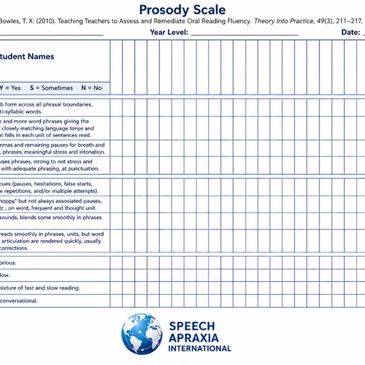
Prosody Screens
Prosody-Voice Screening Profile (PVSP; Shriberg, Kwiatkowski, & Rasmussen, 1990)
https://phonology.waisman.wisc.edu/about-the-pvsp/
Speech Prosody matrix -Teachers pay teachers https://www.pinterest.com/pin/speech-prosody-matrix--81768549490206968/
PEPS-C: a test of prosodic ability PEPS-C: a test of prosodic ability
Apps
The prosody toolkit by Biospeech (Apple App) Search for prosody assessment (not prosody toolkit) https://www.biospeech.com/prosody-toolkit/
Voice analyst https://www.amazon.com/dp/B00PMP30E6?lv=shuf&channelId=500&plpRedirect=mhFallback (Apple app--$17.99; Google Play--$14.99) • Looks at pitch and volume in real-time • Provides visual feedback
Waveform, Spectrogram, and Pitch (WASP) • Free, web-based program • Provides waveform, spectrogram, and pitch track and marks WASP2 - Waveform, Spectrogram and Pitch Display
Praat with Plug-ins Prosody Pro/ProsoBox
Free software • Provides acoustic analysis with waveforms and spectrograms
Plug-ins can provide more sophisticated analyses Praat: doing Phonetics by Computer PRAAT Tutorial
Altering a component of prosody alters the articulatory movements needed to produce the target
Example: increased loudness
More subglottal air pressure, more vocal fold tension, increased jaw and lip aperture which means the tongue position is lowered • Increased Loudness Example: increased stress on syllable Pitch increases, higher volume, longer duration, stressed vowels require increased muscle effort. Articulatory targets for stressed syllable are therefore different. than when unstressed
Do children omit stressed or unstressed syllables? Think "banana" or "television"
Do not stress missing syllable because it teaches incorrect lexical stress •
Try backward chaining for multisyllabic productions • " Vi-sion" "le-vi-sion" "te-le-vi-sion"
Very young children
Interactive/Modeling of Vocalizations • Babble Boot Camp (Peter et al., 2019) • Model/imitate at level of development • Coo • Babbling • Reading stories • Singing (alerting baby to rhythms) • Use IDS (emphasize prosodic cues)
Babble Boot Camp (BBC) Training | Online ASHA CEUs
Storybooks (electronic and hard copy) that can help
Lexical stress and inflection (changing pitch, tone, loudness)
Yo! Yes? By: Chris Raschka • (2007) (2014) Yo! Yes? By: Chris Raschka - YouTube
Moo by David LaRochelle with illustrations by Mike Wohnoutka Moo by David LaRochelle with illustrations by Mike Wohnoutka Childrens Read Aloud Bedtime Stories - YouTube
Childrens Read Aloud Bedtime Stories Up, Up, Down by R. Munsch (2020) Up, Up, Down - YouTube
Techniques to Work on Prosody - YouTube Edythe Strand
Intonation (Fish & Skinder-Meridith, 2023)
Targeting rising and falling intonation
Providing visuals and multi-sensory cues to support understanding and modulation of intonation • Activities to differentiate between rising and falling intonation to improve understanding and perceptual skills
Falling intonation
Counting
Making declarative statements including answer questions
Rising intonation • Asking questions
SQR Method (see Fish & Skinder-Meredith, 2023) •
Statement (clinician or printed): The dog is loud. •
Question (clinician): How does the dog sound? •
Response (child): The dog is LOUD. Question: What is loud?
Response: The DOG is loud.
May use visuals to highlight stressed words
Phonological awareness
Why working on speech alone may not be sufficient -language should also be assessed
Why working on speech alone may not be sufficient -language should also be assessed
Speech apraxia especially developmental, can affect the ability to detect parts of speech or 'phonemes.' It can affect reading, writing, and spelling.
About the NIPA | Newcastle Phonological Awareness | Newcastle University includes assessment and intervention suitable for all children but specifically for children with SLCN. This interv
Speech apraxia especially developmental, can affect the ability to detect parts of speech or 'phonemes.' It can affect reading, writing, and spelling.
About the NIPA | Newcastle Phonological Awareness | Newcastle University includes assessment and intervention suitable for all children but specifically for children with SLCN. This intervention provides adaptable session plans for SLTs.
by Gillon, A Better start to Reading and for preschool children with SSD.
About the NIPA | Newcastle Phonological Awareness | Newcastle University
APAR - Assessment of Phonological Awareness and Reading - Home page
Why working on speech alone may not be sufficient -language should also be assessed
Why working on speech alone may not be sufficient -language should also be assessed
Why working on speech alone may not be sufficient -language should also be assessed
It may be that other areas also need a focus. Resources such as Elklan products will provide a good basis for holistic intervention www.elklan.co.uk
- Attention and listening
- Helping school age children understand spoken language and develop verbal reasoning skills
- Helping school age children develop their expressive language
- Phonological proc
It may be that other areas also need a focus. Resources such as Elklan products will provide a good basis for holistic intervention www.elklan.co.uk
- Attention and listening
- Helping school age children understand spoken language and develop verbal reasoning skills
- Helping school age children develop their expressive language
- Phonological processing activities
- Developing vocabulary and story writing and use of mind maps
- Helping school age children develop their social skills
- Helping school age children with unclear speech
Structured Assessment for Childhood Apraxia of Speech (CAS)
Why working on speech alone may not be sufficient -language should also be assessed
Structured Assessment for Childhood Apraxia of Speech (CAS)
A Structured Assessment for Childhood Apraxia of Speech (CAS)
No single assessment can diagnose Childhood Apraxia of Speech (CAS). Instead, assessment involves combining information from several tasks to identify the characteristic features of CAS while ruling out other speech sound disorders.
Key Terms
- Oral motor skills – Movements of the l
A Structured Assessment for Childhood Apraxia of Speech (CAS)
No single assessment can diagnose Childhood Apraxia of Speech (CAS). Instead, assessment involves combining information from several tasks to identify the characteristic features of CAS while ruling out other speech sound disorders.
Key Terms
- Oral motor skills – Movements of the lips, tongue, jaw and soft palate used for eating, drinking and non-speech tasks.
- Oral apraxia – Difficulty planning and carrying out voluntary mouth movements that are not related to speaking (e.g. sticking out the tongue on request). Oral apraxia often occurs alongside CAS but is not required for a diagnosis.
- Phonemic inventory – The speech sounds (consonants and vowels) a child can produce correctly.
- Speech sample – A recording of the child's spontaneous speech during conversation or play.
- Dynamic assessment – An assessment in which the clinician provides different cues and repeated attempts to see how the child's speech changes with support.
- Stimulability – How easily a child can produce a sound or word after being given a model or cues.
- Syllable structure – The pattern of consonants and vowels within a word (e.g. CV = "me", CVC = "cat", CVCV = "baby").
- Cueing – Strategies used by the therapist to help speech production, such as visual, verbal, tactile or gesture cues.
- Core characteristics of CAS – The speech features most strongly associated with Childhood Apraxia of Speech, such as inconsistent errors, disrupted transitions between sounds, and inappropriate stress.
Step 1: Non-Speech Oral Motor Examination (NSOME)
Purpose
To assess how well the child can move their lips, tongue and jaw during non-speech tasks.
Why is this important?
This assessment helps determine whether the child has oral apraxia, which is difficulty planning voluntary mouth movements that are unrelated to speech. Although oral apraxia is more common in children with CAS, it does not diagnose CAS on its own.
Step 2: Phonemic Inventory
Purpose
To identify which speech sounds the child can already produce.
Why is this important?
Knowing the child's sound repertoire helps the therapist choose appropriate therapy targets. Therapy is usually most successful when initial target words contain sounds that the child can already produce independently or with prompting.
This assessment usually considers all 22 English consonants and 12 English vowels.
Step 3: Speech Sample
Purpose
To observe the child's everyday speech during natural communication.
Why is this important?
A spontaneous speech sample allows the therapist to:
- identify speech sounds used naturally
- observe consistency of errors
- listen for the core characteristics of CAS
- understand how speech differs in conversation compared with structured testing.
Step 4: Dynamic Articulation Assessment
Purpose
To assess how consistently the child produces speech sounds across repeated attempts.
Why is this important?
Unlike a standard articulation test, a dynamic assessment asks the child to attempt the same sounds or words several times while different levels of support are provided.
Children with CAS are often consistently inconsistent—they may produce the same word differently each time they say it. Repeated trials are therefore essential to identify this important feature.
Step 5: Dynamic Motor Speech Assessment
Purpose
To identify the level of speech complexity at which the child's speech begins to break down.
Why is this important?
The assessment examines increasingly complex syllable shapes and words to determine the child's current motor speech abilities. This helps ensure therapy targets are challenging enough to encourage progress while still allowing success.
During this assessment the therapist aims to:
- identify the core characteristics of CAS
- determine which syllable structures are most difficult
- assess stimulability
- identify which cueing strategies are most effective for that child.
Step 6: Core Word List
Purpose
To develop a small set of highly functional words that the child can practise consistently.
Why is this important?
Children with severe CAS or a limited vocabulary often struggle to combine individual words into longer phrases because each new word sequence requires additional motor planning.
For example, a child may be able to say:
- "go away"
- "dinosaur"
but struggle to produce:
- "Go away, dinosaur."
Practising a consistent set of everyday words helps build confidence and supports the development of longer, more accurate utterances.
Interpreting the Results
The clinician should review the findings from the speech sample, dynamic articulation assessment, and dynamic motor speech assessment together.
If the child demonstrates four or more core characteristics of CAS across three or more assessment contexts, this provides evidence that CAS is likely.
It is important to remember that CAS can occur alongside other speech sound disorders, such as a phonological disorder. A child with both conditions may require treatment that addresses both:
- Motor planning and sequencing (for CAS), and
- Speech sound patterns (for phonological disorder).
Accurate differential diagnosis is essential because a phonological therapy approach alone does not address the underlying motor planning difficulties seen in Childhood Apraxia of Speech.